
LORVIQUA FILM-COATED TABLET 100MG
4.1 Therapeutic indications
LORVIQUA is indicated for the first line treatment of adult patients with anaplastic lymphoma kinase (ALK)-positive advanced non-small cell lung cancer (NSCLC).
LORVIQUA is indicated for the treatment of patients with anaplastic lymphoma kinase (ALK)-positive metastatic non-small cell lung cancer (NSCLC) whose disease has progressed on
- crizotinib and at least one other ALK inhibitor for metastatic disease; or
- alectinib as the first ALK inhibitor therapy for metastatic disease; or
- ceritinib as the first ALK inhibitor therapy for metastatic disease.
4.3 Contraindications
Concomitant use of strong CYP3A inducers with lorlatinib is contraindicated due to the potential for serious hepatotoxicity (aspartate aminotransferase [AST] and alanine aminotransferase [ALT] elevations) (see Sections 4.4 and 4.5 – please refer to the Product Insert/Patient Information Leaflet published on HSA for the full drug information).
4.2 Posology and method of administration
ALK testing
Detection of ALK-positive NSCLC is necessary for selection of patients for treatment with lorlatinib because these are the only patients for whom benefit has been shown. Assessment for ALK-positive NSCLC should be performed by laboratories with demonstrated proficiency in the specific technology being utilised. Improper assay performance can lead to unreliable test results.
Recommended dosing
The recommended dose schedule of LORVIQUA is 100 mg taken orally once daily continuously. Continue treatment until disease progression or unacceptable toxicity.
LORVIQUA may be taken with or without food (see Section 5.2 – please refer to the Product Insert/Patient Information Leaflet published on HSA for the full drug information).
Patients should be encouraged to take their dose of lorlatinib at approximately the same time each day. Tablets should be swallowed whole (tablets should not be chewed, crushed or split prior to swallowing). No tablet should be ingested if it is broken, cracked, or otherwise not intact.
If a dose of lorlatinib is missed, then it should be taken as soon as the patient remembers unless it is less than 4 hours before the next dose, in which case the patient should not take the missed dose. Patients should not take 2 doses at the same time to make up for a missed dose.
Dose modifications
Dosing interruption and/or dose reduction may be required based on individual safety and tolerability. Dose reduction levels are summarized below.
- First dose reduction: LORVIQUA 75 mg taken orally once daily
- Second dose reduction: LORVIQUA 50 mg taken orally once daily
LORVIQUA should be permanently discontinued if the patient is unable to tolerate LORVIQUA 50 mg taken orally once daily.
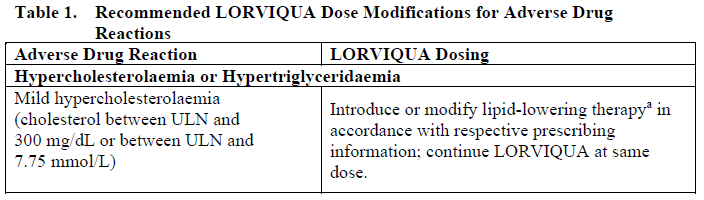
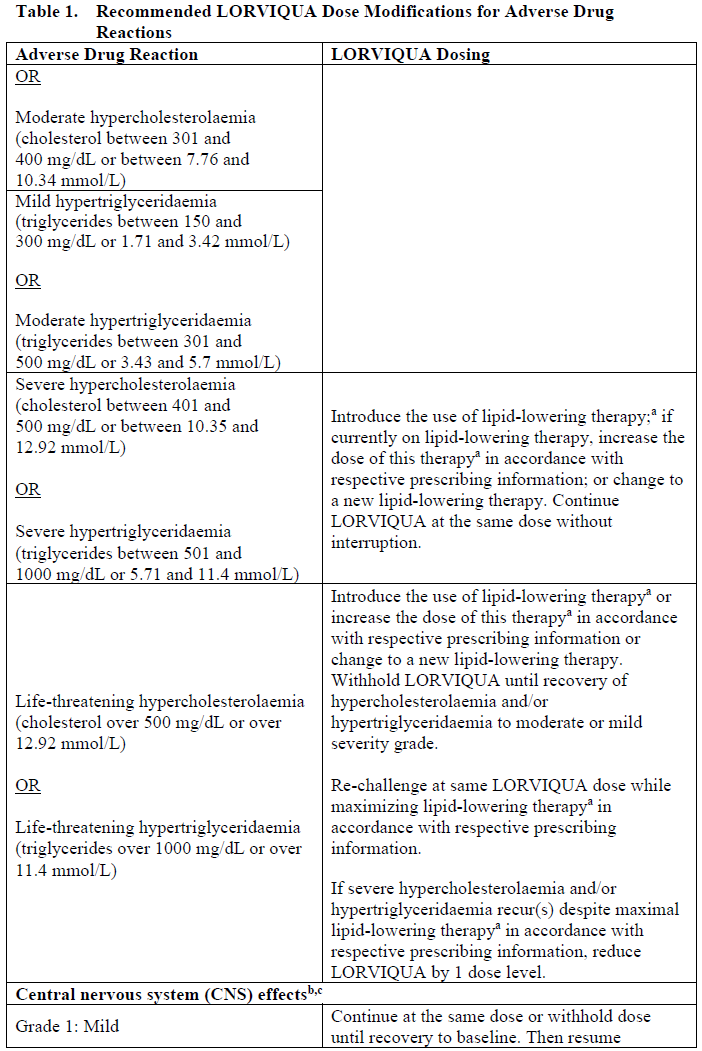
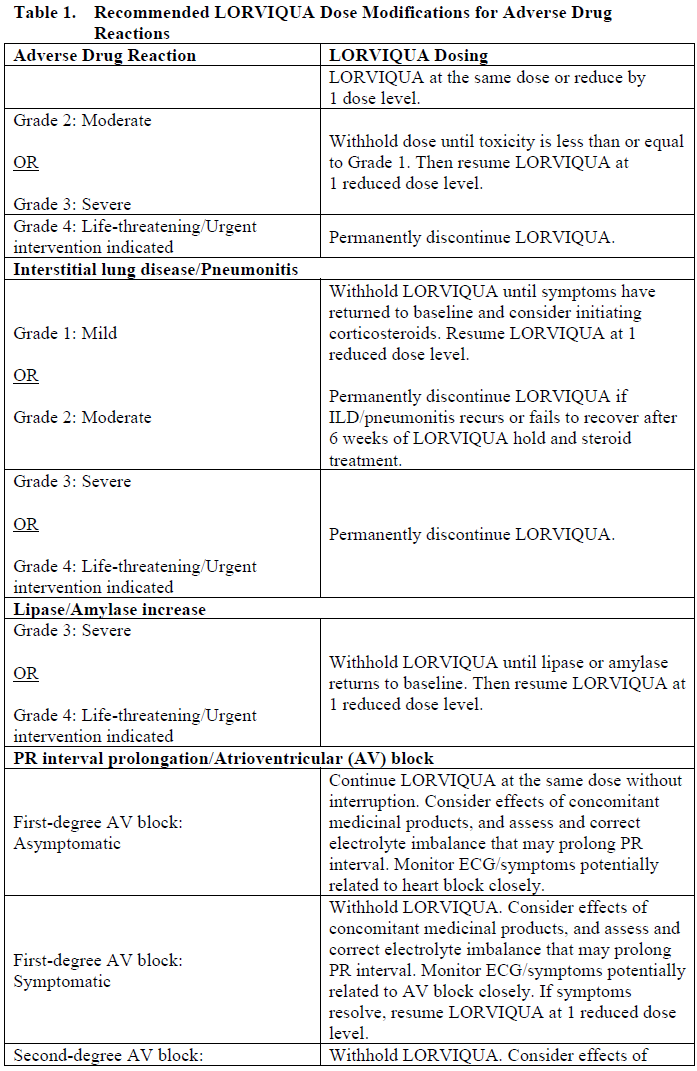
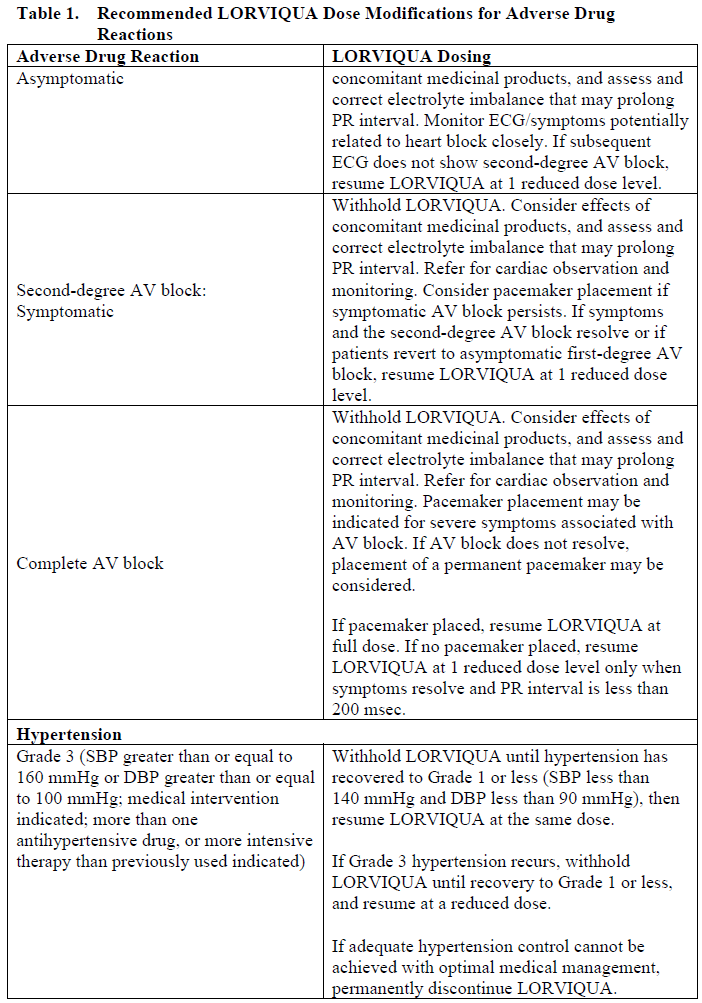
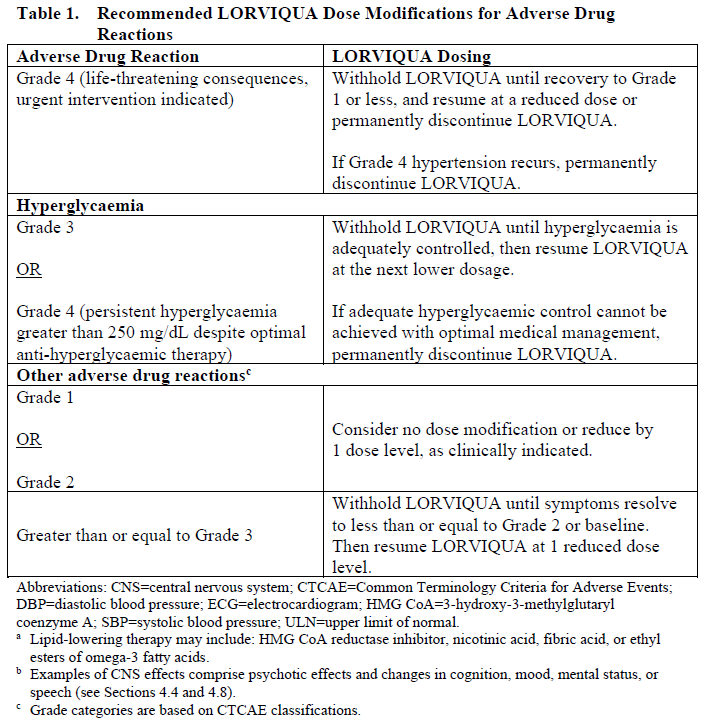
Dose modification recommendations for toxicities and for patients who develop first-degree, second-degree, or complete atrioventricular (AV) block are provided in Table 1.
Strong cytochrome P-450 (CYP)3A inhibitors
Concurrent use of LORVIQUA with strong CYP3A inhibitors may increase lorlatinib plasma concentrations. An alternative concomitant medicinal product with less potential to inhibit CYP3A should be considered (see Sections 4.5 and 5.2 – please refer to the Product Insert/Patient Information Leaflet published on HSA for the full drug information). If a strong CYP3A inhibitor must be administered concomitantly, the starting LORVIQUA dose of 100 mg once daily should be reduced to once daily 75 mg dose. If concurrent use of a strong CYP3A inhibitor is discontinued, LORVIQUA should be resumed at the dose used prior to the initiation of the strong CYP3A inhibitor and after a washout period of 3 to 5 half-lives of the strong CYP3A inhibitor.
Hepatic impairment
No dose adjustments are recommended for patients with mild hepatic impairment. Limited information is available for lorlatinib in patients with moderate or severe hepatic impairment. Therefore, LORVIQUA is not recommended in patients with moderate to severe hepatic impairment (see Section 5.2 – please refer to the Product Insert/Patient Information Leaflet published on HSA for the full drug information).
Renal impairment
No dose adjustment is needed for patients with mild or moderate renal impairment [absolute estimated glomerular filtration rate (eGFR): ≥30 mL/min]. A reduced dose of LORVIQUA is recommended in patients with severe renal impairment (absolute eGFR <30 mL/min), e.g., a starting dose of 75 mg taken orally once daily (see Section 5.2 – please refer to the Product Insert/Patient Information Leaflet published on HSA for the full drug information).
Elderly (≥65 years)
The limited data on the safety and efficacy of lorlatinib in patients aged 65 years and older do not suggest that a dose adjustment is required in elderly patients (see Section 5.2 – please refer to the Product Insert/Patient Information Leaflet published on HSA for the full drug information).
Pediatric patients
The safety and efficacy of lorlatinib in pediatric patients has not been established.
