
MEKINIST FILM-COATED TABLETS 0.5MG
3 Indications
Unresectable or metastatic melanoma
Trametinib as monotherapy or in combination with dabrafenib is indicated for the treatment of adult patients with unresectable or metastatic melanoma with a BRAF V600 mutation ( see section 6 Warnings and Precautions and section 12 Clinical studies – please refer to the Product Insert/Patient Information Leaflet published on HSA for the full drug information).
Trametinib monotherapy has not demonstrated clinical activity in patients who have progressed on a prior BRAF inhibitor therapy (see section 12 Clinical studies – please refer to the Product Insert/Patient Information Leaflet published on HSA for the full drug information ).
Adjuvant treatment of melanoma
Trametinib in combination with dabrafenib is indicated for the adjuvant treatment of patients with melanoma with BRAF V600 mutation and involvement of lymph node(s), following complete resection.
Advanced non-small cell lung cancer
Trametinib in combination with dabrafenib is indicated for the treatment of adult patients with advanced non-small cell lung cancer (NSCLC) with a BRAF V600 mutation.
Locally advanced or metastatic anaplastic thyroid cancer
Trametinib in combination with dabrafenib is indicated for the treatment of patients with locally advanced or metastatic anaplastic thyroid cancer (ATC) with a BRAF V600 mutation and with no satisfactory locoregional treatment options (see section 12 Clinical studies – please refer to the Product Insert/Patient Information Leaflet published on HSA for the full drug information ).
5 Contraindications
Hypersensitivity to the active substance or to any of the excipients listed.
4 Dosage regimen and administration
Treatment with trametinib should only be initiated and supervised by a physician experienced in the administration of anti-cancer medicinal products.
Before taking trametinib, patients must have confirmation of BRAF V600 mutation using a validated test.
When Mekinist is used in combination with Tafinlar, please also refer to the full Tafinlar Package Insert.
Dosage regimen
General target population
Adults
Recommended Dosage for Unresectable or Metastatic Melanoma
The recommended dose of trametinib, either used as monotherapy or in combination with dabrafenib, is 2 mg once daily. The recommended dose of dabrafenib, when used in combination with trametinib, is 150 mg twice daily. It is recommended that patients continue treatment with trametinib until patients no longer derive benefit or the development of unacceptable toxicity.
Recommended Dosage for the Adjuvant Treatment of Melanoma
The recommended dose of trametinib in combination with dabrafenib is 2 mg once daily. The recommended dose of dabrafenib, when used in combination with trametinib, is 150 mg twice daily, until disease recurrence or unacceptable toxicity for up to 1 year.
Recommended Dosage for NSCLC
The recommended dose of trametinib in combination with dabrafenib, is 2 mg once daily. The recommended dose of dabrafenib, when used in combination with trametinib, is 150 mg twice daily. It is recommended that patients continue treatment with trametinib until patients no longer derive benefit or the development of unacceptable toxicity.
Recommended Dosage for ATC
The recommended dose of trametinib in combination with dabrafenib, is 2 mg once daily. The recommended dose of dabrafenib, when used in combination with trametinib, is 150 mg twice daily, until disease recurrence or unacceptable toxicity.
Missed doses
If a dose of trametinib is missed, it should only be taken if it is more than 12 hours until the next scheduled dose.
If a dose of dabrafenib is missed, when trametinib is given in combination with dabrafenib, the dose of dabrafenib should only be taken if it is more than 6 hours until the next scheduled dose.
Dose adjustments
Mekinist as monotherapy and in combination with Tafinlar
The management of adverse events/adverse drug reactions may require treatment interruption, dose reduction, or treatment discontinuation.
Dose modifications are not recommended for adverse reactions of cutaneous squamous cell carcinoma (cuSCC) or new primary melanoma (see dabrafenib Package Insert for further details).
Recommended dose level reductions are provided in Table 4-1. Doses below 1 mg once daily are not recommended.
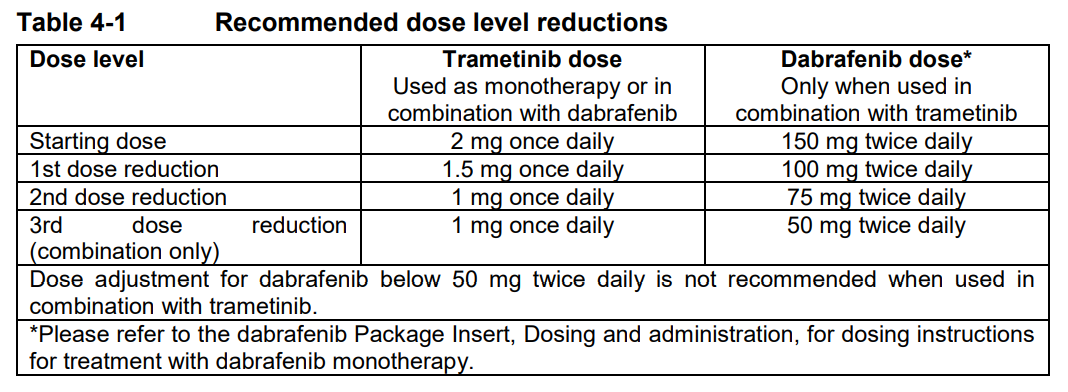
The recommended dose modification schedule is provided in Table 4-2. When an individual’s adverse reactions are under effective management, dose re-escalation following the same dosing steps as de-escalation may be considered. The Mekinist dose should not exceed 2 mg once daily.
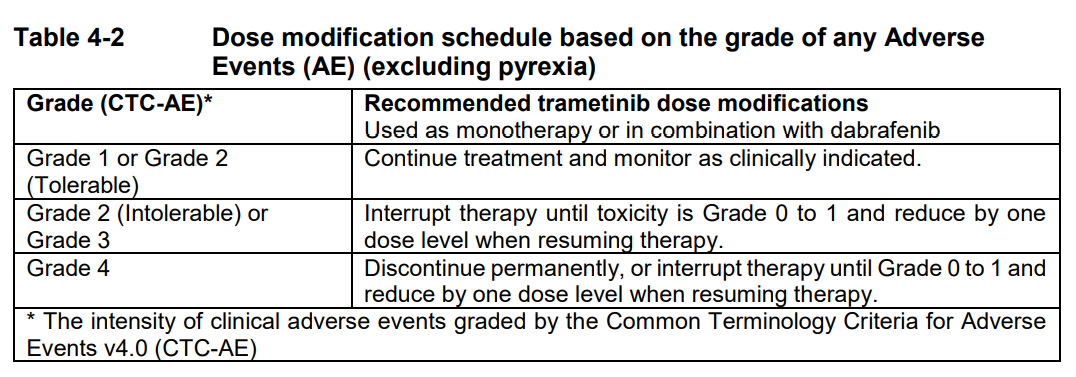
If treatment-related toxicities occur when trametinib is used in combination with dabrafenib, then both treatments should be simultaneously dose reduced, interrupted or discontinued.
Exceptions where dose modifications are necessary for only one of the two treatments are detailed below for pyrexia, uveitis, RAS mutation positive non-cutaneous malignancies (primarily related to dabrafenib), left ventricular ejection fraction (LVEF) reduction, retinal vein occlusion (RVO), retinal pigment epithelial detachment (RPED) and interstitial lung disease (ILD)/pneumonitis (primarily related to trametinib).
Dose modification exceptions (where only one of the two therapies is dose reduced) for selected adverse reactions
Pyrexia
Therapy should be interrupted (Mekinist when used as monotherapy, and both Mekinist and Tafinlar when used in combination) if the patient’s temperature is ≥38°C (100.4°F). In case of recurrence, therapy can also be interrupted at the first symptom of pyrexia. Treatment with anti-pyretics such as ibuprofen or acetaminophen/paracetamol should be initiated. Patients should be evaluated for signs and symptoms of infection (see section 6 Warnings and precautions – please refer to the Product Insert/Patient Information Leaflet published on HSA for the full drug information). Mekinist, or both Mekinist and Tafinlar when used in combination, should be restarted if patient is symptom free for at least 24 hours either (1) at the same dose level, or (2) reduced by one dose level, if pyrexia is recurrent and/or was accompanied by other severe symptoms including dehydration, hypotension, or renal failure. The use of oral corticosteroids should be considered in those instances in which anti-pyretics are insufficient.
Uveitis
No dose modifications are required for uveitis as long as effective local therapies can control ocular inflammation. If uveitis does not respond to local ocular therapy, dabrafenib should be withheld until resolution of ocular inflammation and then dabrafenib should be restarted reduced by one dose level. No dose modification of trametinib is required when taken in combination with dabrafenib (see section Warnings and Precautions – please refer to the Product Insert/Patient Information Leaflet published on HSA for the full drug information ).
RAS-mutation-positive non-cutaneous malignancies
Consider the benefits and risks before continuing treatment with dabrafenib in patients with a non-cutaneous malignancy that has a RAS mutation. No dose modification of trametinib is required when taken in combination with dabrafenib.
Left ventricular ejection fraction (LVEF) reduction/Left ventricular dysfunction
Trametinib should be interrupted in patients who have an asymptomatic, absolute decrease of >10% in LVEF compared to baseline and the ejection fraction below the institution’s lower limit of normal (LLN) (see section Warnings and Precautions – please refer to the Product Insert/Patient Information Leaflet published on HSA for the full drug information ). No dose modification of dabrafenib is required when trametinib is taken in combination with dabrafenib. If the LVEF recovers, treatment with trametinib may be restarted, but the dose should be reduced by one dose level with careful monitoring ( see section Warnings and Precautions – please refer to the Product Insert/Patient Information Leaflet published on HSA for the full drug information).
Trametinib should be permanently discontinued in patients with Grade 3 or 4 left ventricular cardiac dysfunction or clinically significant LVEF reduction which does not recover within 4 weeks ( see section Warnings and Precautions – please refer to the Product Insert/Patient Information Leaflet published on HSA for the full drug information).
Retinal vein occlusion (RVO) and Retinal pigment epithelial detachment (RPED)
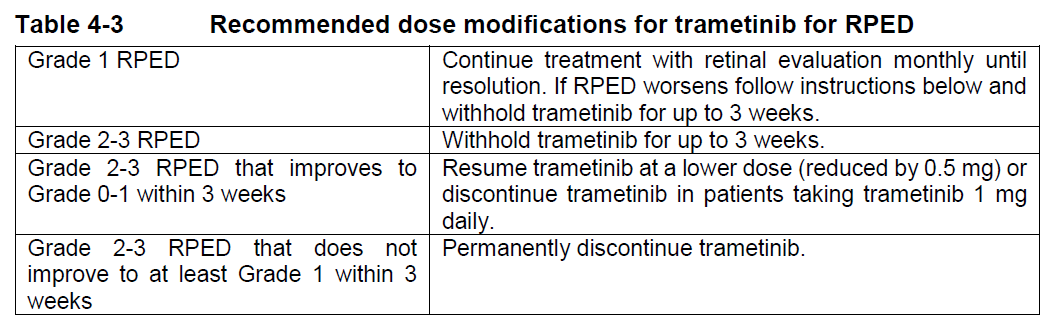
If patients report new visual disturbances such as diminished central vision, blurred vision, or loss of vision at any time while on trametinib therapy, a prompt ophthalmological assessment is recommended. In patients who are diagnosed with RVO, treatment with trametinib, whether given as monotherapy or in combination with dabrafenib, should be permanently discontinued. No dose modification of dabrafenib is required when trametinib is taken in combination with dabrafenib. If RPED is diagnosed, follow the dose modification schedule in Table 4-3 below for trametinib ( see section Warnings and Precautions – please refer to the Product Insert/Patient Information Leaflet published on HSA for the full drug information).
Interstitial lung disease (ILD)/Pneumonitis
Withhold trametinib in patients with suspected ILD or pneumonitis, including patients presenting with new or progressive pulmonary symptoms and findings including cough, dyspnoea, hypoxia, pleural effusion, or infiltrates, pending clinical investigations. Permanently discontinue trametinib for patients diagnosed with treatment-related ILD or pneumonitis. No dose modification of dabrafenib is required when trametinib is taken in combination with dabrafenib for cases of ILD or pneumonitis.
Special populations
Renal impairment
No dosage adjustment is required in patients with mild or moderate renal impairment. Mild or moderate renal impairment had no significant effect on the population pharmacokinetics of Mekinist ( see section Clinical pharmacology, Pharmacokinetics – please refer to the Product Insert/Patient Information Leaflet published on HSA for the full drug information). There are no clinical data in patients with severe renal impairment; therefore, the potential need for starting dose adjustment cannot be determined. Trametinib should be used with caution in patients with severe renal impairment when administered as monotherapy or in combination with dabrafenib.
Hepatic impairment
No dosage adjustment is required in patients with mild hepatic impairment. In a population pharmacokinetic analysis, trametinib oral clearance and thus exposure was not significantly different in patients with mild hepatic impairment compared to patients with normal hepatic function. Available data in patients with moderate or severe hepatic impairment from a clinical pharmacology study indicate a limited impact on trametinib exposure (see section Clinical pharmacology, Pharmacokinetics – please refer to the Product Insert/Patient Information Leaflet published on HSA for the full drug information ). Trametinib should be used with caution in patients with moderate or severe hepatic impairment when administered as monotherapy or in combination with dabrafenib.
Non-Caucasian patients
The safety and efficacy of trametinib in non-Caucasian patients have not been established. No data are available.
Geriatric patients (65 years of age or above)
No dose adjustment is required in patients 65 years of age or older (see section Clinical pharmacology, Pharmacokinetics – please refer to the Product Insert/Patient Information Leaflet published on HSA for the full drug information ). More frequent dose adjustments (see Tables 4-1 and 4-2 above) may be required in patients 65 years of age or older ( see section Adverse Drug Reactions – please refer to the Product Insert/Patient Information Leaflet published on HSA for the full drug information).
Pediatric patients (below 18 years)
The safety and efficacy of trametinib in pediatric patients have not been established. Mekinist is not recommended in this age group. No data are available. Studies in juvenile animals have shown adverse effects of trametinib which had not been observed in adult animals ( see section Non-clinical safety data – please refer to the Product Insert/Patient Information Leaflet published on HSA for the full drug information).
Method of administration
Trametinib should be taken orally with a full glass of water. Trametinib tablets should not be chewed or crushed. Trametinib should be taken without food, at least 1 hour before or 2 hours after a meal (see section Clinical pharmacology – please refer to the Product Insert/Patient Information Leaflet published on HSA for the full drug information ).
It is recommended that the dose of trametinib is taken at a similar time every day. When trametinib and dabrafenib are taken in combination, the once-daily dose of trametinib should be taken at the same time each day with either the morning dose or the evening dose of dabrafenib.
If a patient vomits after taking trametinib, the patient should not retake the dose and should take the next scheduled dose.
Please refer to dabrafenib Package Insert for information on method of administration when given in combination with trametinib.
