
KERENDIA FILM-COATED TABLET 10MG
4.1 Indication(s)
Kerendia, in addition to standard of care, is indicated to reduce the risk of sustained eGFR decline, end-stage kidney disease, cardiovascular death, non-fatal myocardial infarction and hospitalization for heart failure in adults with chronic kidney disease and albuminuria associated with type 2 diabetes.
4.3 Contraindications
Kerendia is contraindicated in patients:
- taking concomitant medications that are strong CYP3A4 inhibitors (e.g., itraconazole, ketoconazole, ritonavir, nelfinavir, cobicistat, clarithromycin, telithromycin and nefazodone) (see section ‘Interaction with other medicinal products and other forms of interaction’ – please refer to the Product Insert/Patient Information Leaflet published on HSA for the full drug information ).
- with Addison’s disease.
4.2 Dosage and method of administration
4.2.1 Method of administration
Oral use
Tablets may be taken with a glass of water and with or without food (see section ‘Pharmacokinetic properties’ – please refer to the Product Insert/Patient Information Leaflet published on HSA for the full drug information ).
Avoid taking Kerendia with grapefruit or grapefruit juice (see section ‘Special warnings and precautions for use’ and ‘4.5 Interaction with other medicinal products and other forms of interaction’ – please refer to the Product Insert/Patient Information Leaflet published on HSA for the full drug information ).
For patients who are unable to swallow whole tablets, Kerendia tablet may be crushed and mixed with water or soft foods, such as applesauce, immediately prior to use and administered orally (see section ‘Pharmacokinetic properties’ – please refer to the Product Insert/Patient Information Leaflet published on HSA for the full drug information ).
4.2.2 Dosage regimen
The recommended target dose of Kerendia is 20 mg once daily.
4.2.2.1 Initiation of treatment
Initiation of Kerendia treatment is recommended when serum potassium ≤ 4.8 mmol/L.
For monitoring of serum potassium, see ‘Continuation of treatment’.
If serum potassium > 4.8 to 5.0 mmol/L, initiation of Kerendia treatment may be considered with additional serum potassium monitoring within the first 4 weeks based on patient characteristics and serum potassium levels (see section ‘Special warnings and precautions for use’ – please refer to the Product Insert/Patient Information Leaflet published on HSA for the full drug information ).
If serum potassium > 5.0 mmol/L, initiation of Kerendia treatment is not recommended (see section ‘Special warnings and precautions for use’ – please refer to the Product Insert/Patient Information Leaflet published on HSA for the full drug information ).
Measure estimated glomerular filtration rate (eGFR) to determine the starting dose.
The starting dose of Kerendia is:
- 20 mg once daily if eGFR ≥ 60 mL/min/1.73 m2
- 10 mg once daily if eGFR ≥ 25 to < 60 mL/min/1.73 m2
Initiation of Kerendia treatment is not recommended in patients with eGFR < 25 mL/min/1.73 m2 as clinical experience is limited.
4.2.2.2 Continuation of treatment
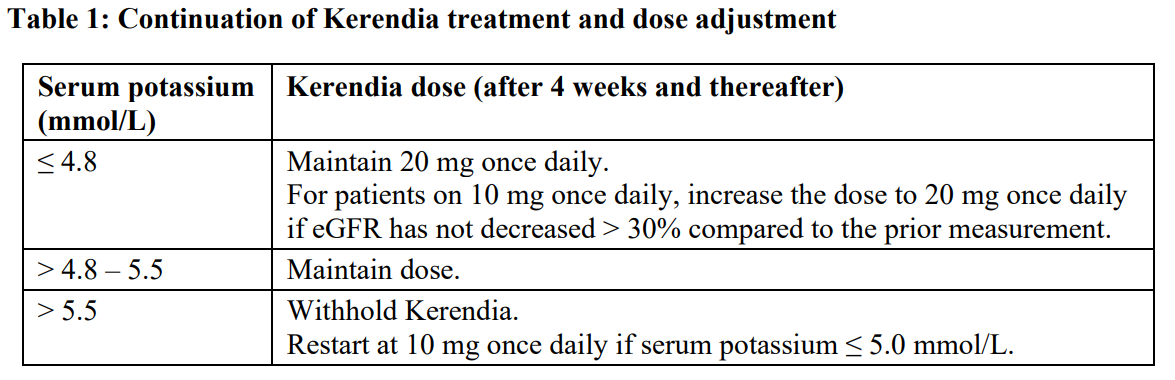
Four weeks after initiation or re-start or up-titration of Kerendia treatment, remeasure serum potassium and eGFR. See Table 1 to determine continuation of Kerendia treatment and dose adjustment.
Thereafter, remeasure serum potassium periodically and as needed based on patient characteristics and serum potassium levels (see section ‘Special warnings and precautions for use’ and ‘4.5 Interaction with other medicinal products and other forms of interaction’ – please refer to the Product Insert/Patient Information Leaflet published on HSA for the full drug information ).
4.2.2.3 Missed doses
A missed dose should be taken as soon as possible after it is noticed, but only on the same day. If this is not possible, the dose should be skipped, and the next dose taken as prescribed. Two doses should not be taken to make up for a missed dose.
The maximum daily dose of Kerendia is 20 mg.
4.2.3 Additional information on special populations
4.2.3.1 Patients with renal impairment
Initiation of Kerendia treatment
In patients with eGFR ≥ 25 to < 60 mL/min/1.73 m2, the starting dose of Kerendia is 10 mg once daily. See section ‘Initiation of treatment’.
In patients with eGFR < 25 mL/min/1.73m2, initiation of Kerendia treatment is not recommended as clinical experience is limited (see section ‘Special warnings and precautions for use’ and section ‘Pharmacokinetic properties’ – please refer to the Product Insert/Patient Information Leaflet published on HSA for the full drug information ).
Continuation of Kerendia treatment
In patients with mild, moderate or severe renal impairment, continue Kerendia treatment and adjust dose based on serum potassium. Measure eGFR 4 weeks after initiation to determine up-titration. See Table 1 and section ‘Continuation of treatment’.
In patients with end-stage renal disease (eGFR < 15 mL/min/1.73 m2), continue Kerendia treatment with caution regarding serum potassium levels as clinical experience is limited (see section ‘Special warnings and precautions for use’ – please refer to the Product Insert/Patient Information Leaflet published on HSA for the full drug information ).
4.2.3.2 Patients with hepatic impairment
In patients with severe hepatic impairment (Child Pugh C), avoid treatment with Kerendia (see section ‘Special warnings and precautions for use’ and section ‘Pharmacokinetic properties’ – please refer to the Product Insert/Patient Information Leaflet published on HSA for the full drug information ). In patients with mild or moderate hepatic impairment, no initial dose adjustment is required (Child Pugh A or B) (see section ‘Pharmacokinetic properties’ – please refer to the Product Insert/Patient Information Leaflet published on HSA for the full drug information ).
In patients with moderate hepatic impairment (Child Pugh B), consider additional serum potassium monitoring and adapt monitoring according to patient characteristics (see section ‘Special warnings and precautions for use’ and section ‘Pharmacokinetic properties’ – please refer to the Product Insert/Patient Information Leaflet published on HSA for the full drug information ).
4.2.3.3 Patients taking concomitant medications
In patients taking Kerendia concomitantly with moderate or weak CYP3A4 inhibitors, potassium supplements, trimethoprim, or trimethoprim-sulfamethoxazole, consider additional serum potassium monitoring and adapt monitoring according to patient characteristics and make Kerendia treatment decisions as directed in Table 1. Temporary discontinuation of Kerendia when taking trimethoprim, or trimethoprim-sulfamethoxazole, may be necessary (see sections ‘Special warnings and precautions for use’ and ‘Interaction with other medicinal products and other forms of interaction’ – please refer to the Product Insert/Patient Information Leaflet published on HSA for the full drug information ).
4.2.3.4 Pediatric patients
The safety and efficacy of Kerendia have not been established in patients under 18 years of age.
Therefore, Kerendia is not recommended for use in pediatric patients.
4.2.3.5 Geriatric patients
No dose adjustment is required in the elderly (see section ‘Pharmacokinetic properties’ – please refer to the Product Insert/Patient Information Leaflet published on HSA for the full drug information ).
4.2.3.6 Gender
No dose adjustment is required based on gender (see section ‘Pharmacokinetic properties’ – please refer to the Product Insert/Patient Information Leaflet published on HSA for the full drug information ).
4.2.3.7 Body weight
No dose adjustment is required based on body weight (see section ‘Pharmacokinetic properties’ – please refer to the Product Insert/Patient Information Leaflet published on HSA for the full drug information ).
4.2.3.8 Ethnic differences
No dose adjustment is required based on ethnic differences (see section ‘Pharmacokinetic properties’ – please refer to the Product Insert/Patient Information Leaflet published on HSA for the full drug information ).
4.2.3.9 Smoking status
No dose adjustment is required based on smoking status (see section ‘Pharmacokinetic properties’ – please refer to the Product Insert/Patient Information Leaflet published on HSA for the full drug information ).
